Vw Jetta EPC Light Meaning and What To Do (This Warning Can Stop Your Car!)

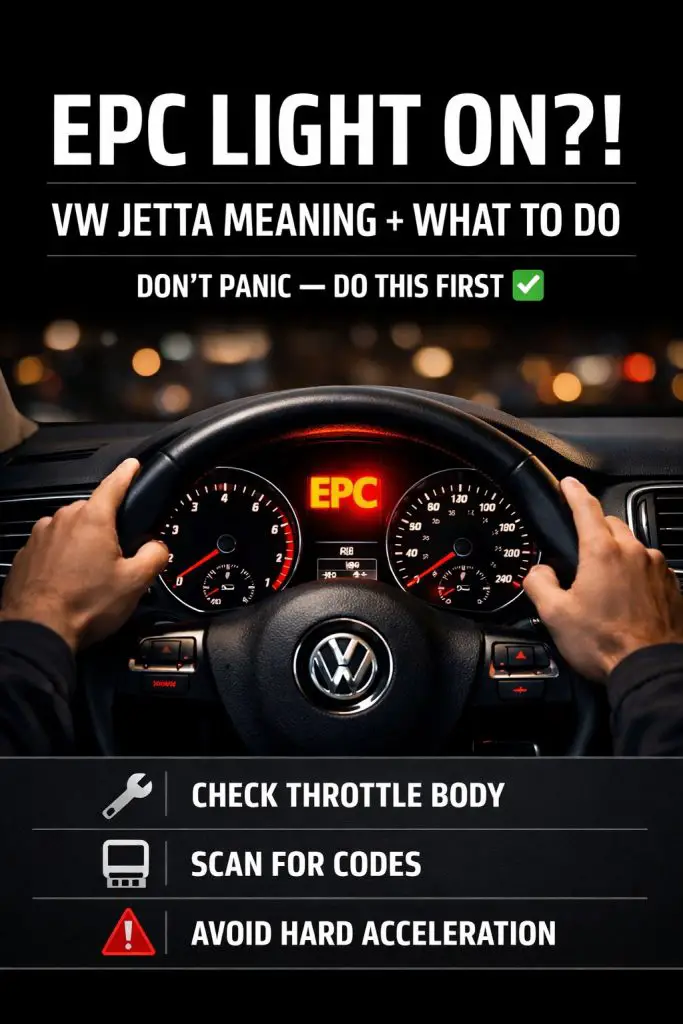
If you drive a VW Jetta, seeing the EPC light pop on can feel like an instant mood killer. One minute the car feels totally normal… and the next, your dashboard is glowing, your acceleration feels weird, and you’re wondering, “Is my Jetta about to die on me?” The biggest problem is that the EPC light doesn’t always come with a clear explanation. It can show up with no warning, sometimes with a check engine light, and sometimes your car suddenly drives like it’s stuck in slow motion.
I’ve been there too, and I’ll be honest — the first time I saw it, I panicked a little. In my opinion, it’s one of the most confusing warning lights because it doesn’t point to one single part. I think most people assume it means “engine failure,” but it’s usually more about the car’s electronic throttle and sensors working together. I’ve dealt with EPC issues on different Volkswagens, and I’ve helped friends troubleshoot it without wasting money on random part replacements.
So don’t worry — this guide will walk you through the VW Jetta EPC light meaning, what causes it, whether it’s safe to drive, and what you should do next. By the end, you’ll know exactly how to react, what to check first, and how to fix it the smart way (without guessing).
What the EPC Light Means on a VW Jetta
The EPC light stands for Electronic Power Control.
In simple terms, it means your VW has detected a problem in the system that controls how the engine responds when you press the gas pedal.
The EPC system is connected to things like:
- Throttle body
- Accelerator pedal sensor
- Engine sensors
- Traction control
- Cruise control
- Brake light switch
- ECU (engine computer)
So when the EPC light comes on, it’s basically your car saying:
✅ “Hey, something in the electronic control system isn’t working right.”
And here’s the important part…
EPC doesn’t always mean the engine is broken — but it DOES mean your car may not drive normally until it’s fixed.
Common Symptoms That Come With the EPC Light
Depending on what triggered it, you might notice one or more of these:
- Loss of power (car feels sluggish)
- Rough idle
- Engine hesitation when accelerating
- Car goes into limp mode
- Check engine light comes on too
- Traction control light appears
- Cruise control stops working
- Engine stalling
- Hard starting
If your Jetta suddenly feels like it “doesn’t want to move,” that’s a huge clue. IMO, that’s when the EPC light becomes more than just “a warning.” It becomes a driving issue you need to take seriously.
Is It Safe to Drive With the EPC Light On?
This is the question everyone asks first, and it’s a good one.
Here’s the truth: sometimes yes… but sometimes absolutely not.
You might be able to drive short distance if:
- The car still accelerates normally
- No shaking or misfiring
- No flashing check engine light
- No heavy loss of power
You should NOT keep driving if:
- The car is stuck in limp mode
- The EPC light is flashing
- The engine is shaking or misfiring
- You smell burning
- You can barely accelerate
- The brake pedal feels weird
- The car stalls or struggles to stay running
If the EPC light is paired with a flashing check engine light, stop driving. That usually indicates an active misfire which can damage your catalytic converter.
If it’s steady and the car is driveable, you can limp it home or to a mechanic — but don’t ignore it for days.
Why Your VW Jetta EPC Light Comes On (Causes)
The EPC system is linked to a lot of things, but there are a few repeat offenders that show up all the time.
Throttle Body Problems
Your throttle body controls how much air enters the engine. If it gets dirty, sticks, or fails electronically, the EPC light may trigger.
Signs this is the issue:
- Rough idle
- Slow response when hitting gas
- Surging RPMs
- Limp mode
A dirty throttle body is one of the most common causes.
Bad Accelerator Pedal Sensor
Modern VW Jettas don’t use a “cable” to control throttle the old-school way. Your gas pedal sends a signal electronically.
If that signal becomes unreliable, the EPC light comes on.
Common symptoms:
- Random loss of power
- Weird acceleration
- EPC light appears when you press the pedal
Faulty Brake Light Switch
This one surprises people.
The brake light switch affects EPC because the car needs to know when you’re braking vs accelerating (especially for throttle control, cruise control, and stability systems).
If the brake light switch is bad, you may notice:
- EPC light + cruise control not working
- Brake lights acting strange
- EPC light appearing randomly
Misfires or Ignition Problems
If your car is misfiring, the engine computer may reduce power to protect the engine. That can trigger EPC too.
Common reasons:
- Worn spark plugs
- Bad ignition coils
- Fuel injector issues
Symptoms:
- Shaking engine
- Rough acceleration
- Check engine light with codes like P0300–P0304
Mass Air Flow (MAF) Sensor or Air Intake Issues
If the engine computer is getting incorrect airflow readings, it may not control throttle correctly — and EPC can show up.
Signs:
- Poor throttle response
- Stalling
- Weird idle
Throttle Position Sensor (TPS) Issues
Some throttle bodies include the TPS internally. If the sensor gives incorrect readings, the car panics and triggers EPC.
You might feel:
- Jerking acceleration
- Car cuts power randomly
- EPC light comes back quickly after clearing
Wiring or Electrical Problems
It’s not the most fun cause, but it happens.
Loose connectors, corroded plugs, damaged wiring harnesses, or weak grounds can all create EPC faults.
This is more common if:
- You recently had battery work done
- The car has water intrusion
- You hit potholes hard and symptoms started after
Low Battery Voltage or Charging Problems
A weak battery or alternator can cause weird warning lights.
If your Jetta battery is low, you may get:
- EPC light
- ABS light
- Traction control light
- Random dashboard warnings
FYI: Low voltage makes sensors and modules behave “glitchy.”
What To Do When the EPC Light Comes On (Step-by-Step)
If you want the most reliable way to handle it, here’s the process I recommend.
Step 1: Stay Calm and Check How the Car Feels
Ask yourself:
- Is the car accelerating normally?
- Is it shaking or running rough?
- Did it suddenly lose power?
Your car’s behavior is the biggest clue.
Step 2: Look for Other Warning Lights
Check if you see:
- ✅ EPC only
- ✅ EPC + check engine light
- ✅ EPC + traction control light
- ✅ EPC + flashing check engine light
Flashing check engine = stop driving. That’s a serious situation.
Step 3: Restart the Car (Quick Test)
Sometimes EPC triggers temporarily due to sensor confusion.
Turn the car off, wait 30 seconds, and restart.
- If EPC disappears and doesn’t return, it may have been a temporary glitch.
- If it returns quickly, you have a real fault stored.
This doesn’t “fix” the car — it just tells you if it’s intermittent or constant.
Step 4: Scan the Car for Codes (Most Important Step)
This is where most people waste money because they skip it.
Even if the EPC light is on, your car usually stores fault codes in the ECU.
What you need:
- An OBD2 scanner
- Or a VW-friendly scan tool (better)
Scan for:
- Engine codes (P-codes)
- Throttle codes
- EPC-related codes
Common codes include:
- P0121 (Throttle position sensor)
- P2101 / P2111 / P2112 (Throttle actuator issues)
- P0221 (Accelerator pedal sensor)
- P0300–P0304 (Misfires)
Once you have the codes, the fix becomes 10x easier.
Step 5: Do the Most Common Easy Fixes First
Before replacing expensive parts, check these:
- Make sure battery terminals are tight
- Look for cracked intake hose
- Check for vacuum leaks
- Confirm brake lights work normally
- Inspect throttle body connector for looseness
Sometimes the EPC light comes from something simple like a loose plug. No joke.
Solutions: How to Fix the VW Jetta EPC Light
Let’s break down fixes based on the likely cause.
Fix 1: Clean the Throttle Body
If your throttle body is dirty or sticking, cleaning can help.
You may notice an improvement in:
- Idle smoothness
- Throttle response
- Random EPC triggers
Important: Don’t force the throttle plate open aggressively on electronic throttles.
If you’re cleaning it yourself, take your time and use proper cleaner.
Fix 2: Replace the Brake Light Switch (If It’s Faulty)
This fix is common and surprisingly affordable.
A failing brake light switch can cause:
- EPC light
- Cruise control not working
- Strange throttle behavior
If your brake lights are inconsistent, this should be near the top of your list.
Fix 3: Replace Bad Spark Plugs or Ignition Coils
If you scan codes and see misfires, handle this ASAP.
What to replace depends on what your codes show:
- If it’s random misfire: plugs + inspect coils
- If it’s cylinder specific: swap coils between cylinders to test
Misfires can trigger EPC because the ECU reduces power to protect the engine.
Fix 4: Replace Accelerator Pedal Position Sensor
If your pedal position sensor is faulty, the car may “not trust” your throttle input.
A bad pedal sensor often causes:
- Sudden power cuts
- EPC light when accelerating
- Limp mode
This is not as common as throttle body issues, but it’s definitely a real cause.
Fix 5: Repair/Replace Throttle Body (When It’s Failing)
If codes point directly to throttle body failure, you may need replacement.
Typical signs:
- EPC light returns instantly after clearing
- Car stuck in limp mode
- Throttle actuator codes stored
In many cases, a failing throttle body can’t be “cleaned away.”
Fix 6: Fix Wiring or Electrical Connections
If everything checks out but EPC still comes back, wiring may be the issue.
Check for:
- Broken wires near throttle body
- Corrosion in connectors
- Loose engine ground
- Damage near battery area
This is where a mechanic with proper VW diagnostic tools becomes valuable.
What If the EPC Light Comes On and Off Randomly?
Intermittent EPC lights can be the most annoying.
Usually, it’s caused by:
- Dirty throttle body
- Weak battery/charging issues
- Loose connector
- Sensor beginning to fail
- Moisture affecting wiring
If it only happens sometimes, don’t ignore it. It usually gets worse over time.
Here’s what I’d do:
- Scan codes even if the light turns off
- Look for “pending” codes
- Monitor when it happens (cold start? rainy day? acceleration?)
Patterns matter.
How Much Does It Cost to Fix the EPC Light on a VW Jetta?
The cost depends on what’s causing it, but here’s a general idea:
- OBD2 scan: cheap or free at some shops
- Brake light switch: low cost
- Spark plugs: low to medium
- Ignition coils: medium
- Throttle body cleaning: low cost DIY or shop fee
- Throttle body replacement: higher cost
- Wiring repair: varies a lot
The real money-saver is scanning the codes first. Otherwise, people end up replacing parts like it’s a guessing game.
Preventing EPC Light Problems in the Future
You can’t prevent every EPC situation (some parts fail naturally), but you can reduce your chances.
Good habits include:
- Replace spark plugs on schedule
- Keep battery in good health
- Don’t ignore rough idle symptoms
- Use quality fuel if your engine is sensitive
- Clean throttle body occasionally (if recommended)
- Fix small issues before they become big ones
Think of it like this: EPC is often the warning BEFORE the bigger issue hits.
Quick Recap: VW Jetta EPC Light Meaning + What To Do
If you just want the short version, here it is:
- EPC = Electronic Power Control
- It usually means a problem with the throttle system or sensors
- Scan for codes before replacing parts
- Don’t drive if the car is misfiring or stuck in limp mode
- Common causes include:
- Throttle body
- Brake light switch
- Ignition coils / spark plugs
- Pedal sensor
- Wiring or low battery voltage
Once you diagnose it correctly, it’s usually fixable without drama.
FAQs (Expert Answers)
1) What does EPC mean on a VW Jetta?
EPC means Electronic Power Control. It’s a VW warning light that indicates a fault in the system controlling throttle response, engine power management, and related sensors. It often involves the throttle body, accelerator pedal sensor, or electrical signals the ECU relies on.
2) Can I drive my VW Jetta with the EPC light on?
Sometimes yes, but it depends on how the car is running. If the EPC light is on and the car drives normally, you may be able to drive carefully for a short distance. If you experience loss of power, limp mode, shaking, or a flashing check engine light, you should stop driving to avoid damage.
3) Why does my EPC light come on and my car loses power?
That usually happens when the vehicle enters limp mode. The ECU limits power to protect the engine when it detects unsafe or unreliable signals from systems like the throttle body, ignition system, or sensors. Scanning the car for diagnostic trouble codes is the best way to identify the exact reason.
4) Will the EPC light turn off by itself?
It can turn off temporarily if the problem is intermittent, but that doesn’t mean the issue is gone. The fault may still be stored in the ECU. If the EPC light comes on again, the problem is still active and should be diagnosed before it becomes worse.
5) What is the most common fix for the VW Jetta EPC light?
The most common fixes involve throttle body cleaning/replacement, repairing throttle-related wiring, replacing a faulty brake light switch, or addressing ignition misfires with spark plugs or coils. The exact fix depends on the fault codes stored in your car’s computer.

![2001 Volkswagen Golf 2.0 Gls Engine Code [Answered]](https://volkswagenbuddy.com/wp-content/uploads/2024/05/2001-volkswagen-golf-2-0-gls-engine-code-answered_4199-768x531.jpg)
![Volkswagen Jetta Keyless Entry Not Working [Causes & Proven Fixes]](https://volkswagenbuddy.com/wp-content/uploads/2024/05/volkswagen-jetta-keyless-entry-not-working-causes-proven-fixes_3899-768x531.jpg)
![2010 Volkswagen Cc 2.0 Oil Pam Sensor Block Off [Fixed]](https://volkswagenbuddy.com/wp-content/uploads/2024/05/2010-volkswagen-cc-2-0-oil-pam-sensor-block-off-fixed_4519-768x531.jpg)

![Volkswagen Dash Lights Not Working [Solved]](https://volkswagenbuddy.com/wp-content/uploads/2024/05/volkswagen-dash-lights-not-working-solved_3894-768x531.jpg)